

Texas driver’s guide • Updated November 2026
How Much Does Hail Damage Repair Cost in Texas? A Guide to PDR, Estimates and Insurance
From a handful of small dents to a vehicle covered in hail damage, repair bills can look dramatically different. Here is how Texas drivers can understand estimates, insurance deductibles, and the best repair approach.
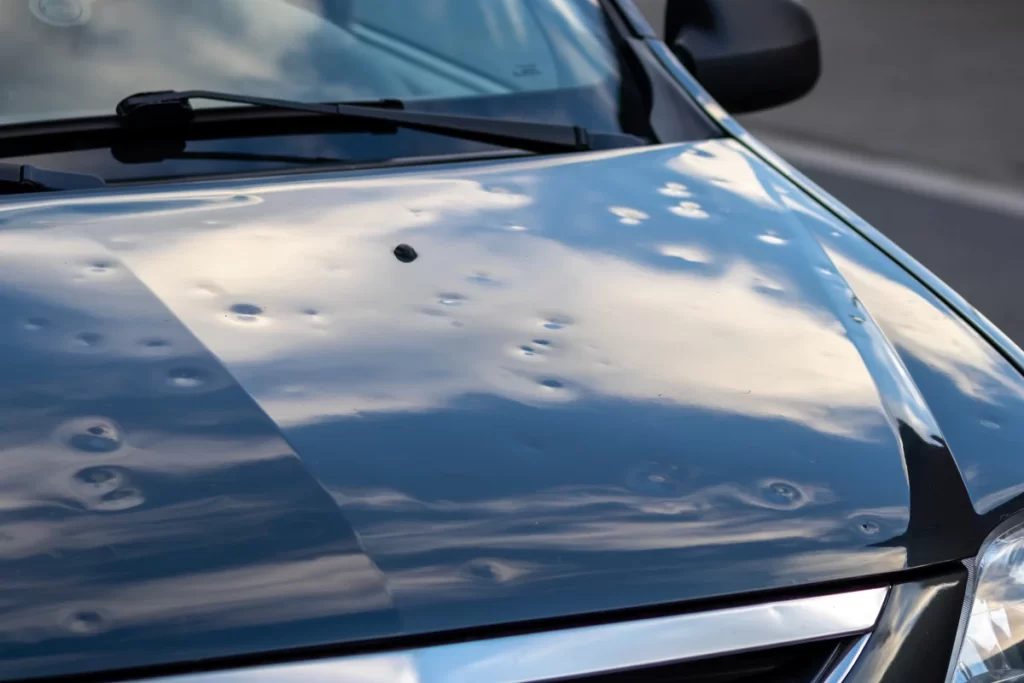
A hailstorm may last only a few minutes, but the dents left behind can lead to a surprisingly complicated repair estimate. One driver might have a few shallow marks on a hood. Another might discover hundreds of dents across the roof, doors and trunk, along with cracked glass. Both vehicles were damaged by hail, but their repair costs could be thousands of dollars apart.
So, how much does hail damage repair cost in Texas? There is no reliable flat statewide price. Some minor dents can be handled with paintless dent repair (PDR) for relatively little money, while widespread storm damage involving multiple panels, refinishing or glass may require a much larger repair. The smartest first step is to understand what drives the estimate, how insurance may apply, and why a proper inspection matters.
How much does hail damage repair cost in Texas?
Published prices can provide context, but they should not be confused with a quote for your own vehicle. For a real Texas example, DG Collision Center in Lewisville published a 2026 pricing sheet describing costs across several hail-damage categories. Its ranges demonstrate why dent severity and the number of affected panels matter so much.
One small dent, cash PDR
$75–$200 per dent
Small qualifying dent; trim access can add labor.
Light hail damage
$750–$1,500
Scattered dents on one or two panels.
Deeper dents on one or two panels
$1,500–$4,000
More challenging dents in a limited area.
Several panels with visible dents
$3,000–$6,500
Damage spread across panels such as the hood, roof and trunk.
Several panels with deep dents or cracked paint
$7,000–$15,000+
May need both PDR and conventional body repair.
Important: These are advertised ranges from one Lewisville-area collision center as published October 6, 2026, not a statewide average, a survey of Texas repair shops, or US Hail Repair’s prices. Actual estimates depend on inspection, vehicle and facility; categories can overlap. View the published source.
What matters more than a ballpark price: How many dents are there? How large and deep are they? Which panels are affected? Is the original paint intact? Those answers determine whether PDR, traditional body repair, or a combination makes sense.
For instance, a single shallow door ding and a roof with dozens of closely spaced hail dents cannot be estimated using the same simple “price per dent.” Full-vehicle repairs may involve carefully counting damage panel by panel, removing and reinstalling trim, correcting inaccessible areas, replacing glass and reviewing manufacturer repair procedures.
Seven factors that influence hail repair costs
1. How many dents need repair?
A professional estimate usually begins by identifying affected panels and documenting damage under suitable lighting. A vehicle with a dozen small dents is very different from one with hundreds of dents across the hood, roof and upper body.
2. Dent size, depth and shape
Small, shallow dents are often easier to reshape than sharp, deep marks that have stretched metal or damaged paint. Dents on body lines can also be more challenging than similar dents on broad, accessible panels.
3. Which panels were hit?
Some panels offer easier tool access than others. Roof rails, double-layered areas and certain enclosed sections can require additional steps. A dent in an easy-to-reach hood may not have the same repair cost as one in a difficult roof-edge area.
4. Steel or aluminum construction
The material and construction of a panel affect repair planning. One real-world example: State Farm’s published PDR agreement pricing matrix provides a 25% matrix adjustment for qualifying aluminum panels, as well as certain other panel or access conditions. That is a specific insurer agreement, not a universal 25% surcharge charged by all repair facilities.
5. Access and disassembly
A technician may need to remove and reinstall interior trim, headliners, lighting components or other parts to reach dents safely. This work, often called R&I (remove and install), can add legitimate labor even when no parts are replaced.
6. Paint, glass and related storm damage
Once paint is cracked, glass is damaged, or trim needs replacement, a purely paintless repair may no longer be sufficient. Repainting, parts replacement, sealing and vehicle-specific electronic safety-system procedures can change the estimate substantially. Learn more about automotive glass replacement.
7. Vehicle design and repair requirements
Vehicle size, body materials, manufacturer repair procedures and replacement-part availability all affect the final repair plan. Two vehicles parked side by side during the same storm may need entirely different repairs.
Why price matrices matter: The State Farm example matrix organizes PDR prices by panel, dent count and average dent size, with separate notes on access and material. It offers a useful illustration of professional estimating complexity; it is not a rate schedule that applies to every insurance company or shop.
Paintless Dent Repair vs. traditional body repair: Which costs less?
Paintless Dent Repair (PDR) reshapes suitable dents while preserving the existing paint finish. Skilled technicians typically use specialized tools from behind the panel or carefully applied pulling techniques from the outside. For damage that qualifies, avoiding sanding, filler and repainting can save steps and preserve the factory finish.
Traditional collision repair is often necessary when paint is broken, metal is too distorted for a satisfactory paintless repair, panels require replacement, or other components are damaged. Sometimes the best plan is a combination: PDR on qualifying dents and conventional repair where it is genuinely needed.
Does it preserve original paint?
Yes, on qualifying damage.
May require refinishing or paint blending.
Best suited for?
Accessible dents with intact paint and workable metal.
Cracked paint, more severe deformation or replacement needs.
Is it always cheaper?
No; often avoids refinishing work, but extensive PDR can still be costly.
May be the appropriate or more economical choice for certain damage.
Can both be used?
Yes. A complete hail estimate may include both methods on different panels.
For a more detailed explanation, read our PDR vs. traditional dent repair comparison. State Farm also publishes a plain-language description of how PDR works.
Will Texas auto insurance cover hail damage repair?
Hail damage is generally handled under the comprehensive portion of an auto insurance policy, rather than liability-only coverage. The Texas Department of Insurance advises drivers to document storm damage and file a claim promptly when they have applicable coverage.
Whether your particular damage is covered, the deductible you pay, and how the claim is settled depend on your policy and your insurer’s evaluation. Check your declarations page for comprehensive coverage and its deductible before assuming the entire repair will be paid for.
How a deductible affects your out-of-pocket cost
For a covered repair, the deductible is generally the part of the loss the policyholder pays. If the covered repair amount is lower than the deductible, the insurer normally has no payment to make. If the covered amount exceeds it, the insurer generally pays the difference, subject to the policy and approved claim amount.
Assumes a covered claim with no additional limits or adjustments
Example A: Small repair
Approved damage: $800
Deductible: $1,000
Insurer payment: $0
Owner pays: $800 if proceeding with the repair
Example B: Moderate repair
Approved damage: $3,500
Deductible: $500
Insurer payment: $3,000
Owner pays: $500
Example C: Extensive repair
Approved damage: $9,000
Deductible: $1,000
Insurer payment: $8,000
Owner pays: $1,000
The examples above are hypothetical arithmetic only, not actual claims, guaranteed payments or statements about the cost of a particular repair. A claim is subject to policy conditions, the insurer’s approved estimate and other relevant circumstances.
Can I choose my own hail repair shop in Texas?
Yes. Texas drivers generally have the right to choose the repair facility. The Texas Department of Insurance explains this consumer right, while noting that an insurer is not required to pay more than a reasonable amount for repair work or parts. You can review our Texas repair-shop choice guide for more detail.
If you are considering whether to file a smaller claim, compare the estimated cost with your comprehensive deductible and ask your insurer about policy-specific considerations. Avoid assuming that a hail claim is automatically free of any possible effect on your insurance costs.
Why an insurance estimate and a repair-shop estimate may differ
An initial insurance estimate is a starting document based on the damage visible and supported when it was prepared. During a detailed shop inspection, technicians may identify additional dents, damaged trim, glass concerns or required access operations not included in that first estimate.
When additional covered repairs are supported, the shop may submit a supplement: an updated estimate and supporting documentation for insurer review. This does not mean every additional charge is automatically approved. The insurer and repair facility must reconcile the scope and price of covered work.
The Texas Department of Insurance’s claims guidance describes how a body shop can submit a revised estimate when the actual repair cost exceeds the insurer’s original estimate. For hail damage, clear photos, panel-by-panel dent documentation and repair-method explanations can be especially helpful.
What should a useful hail estimate explain?
- Which panels are damaged, and approximately how many dents are on each.
- Which areas qualify for PDR and which need another method.
- Whether glass, trim, paint or replacement parts are involved.
- Why any removal-and-installation work or calibration procedures are needed.
- What is included in the quoted amount and what might require supplemental approval.
- What warranty applies to the specific repairs performed.
Why hail damage is a recurring concern for Texas drivers
Texas is not merely a state where hail sometimes happens; it consistently records more major hail reports than other states. According to the Insurance Information Institute’s compilation of NOAA Storm Prediction Center data, Texas recorded 902 reports of hail at least one inch in diameter in 2025. The five leading states are shown below.
Major hail reports by state, 2025
Reported hail events involving stones at least 1 inch in diameter; values do not represent individual cars damaged or insurance claims.
902
375
369
315
253
The chart does not show average vehicle repair prices, and it does not prove that every community in Texas has the same hail risk. Local storms vary by year and area. Still, the figures help explain why drivers in Dallas-Fort Worth and surrounding North Texas communities benefit from knowing how to document storm damage and find a qualified repair facility before they need one.
Is hail damage worth fixing on an older vehicle?
Repair decisions can be different when a vehicle’s market value is relatively low compared with the estimated work. If cosmetic dents are the only concern and there is no exposed metal, glass damage or another safety issue, an owner may decide to compare repair cost with resale plans and the vehicle’s value. However, a vehicle should still be inspected: what looks cosmetic may include hidden damage, and broken paint or glass can need attention.
A severe hail repair estimate can also bring up the question of a total loss. Insurers typically compare the vehicle’s value and the anticipated repair expense under applicable policy and state rules. The Texas Department of Insurance’s total-loss explanation discusses valuation and options when a vehicle is declared totaled. It is better to ask for the insurer’s actual valuation and calculation than assume that one universal percentage controls every case.
Before choosing to keep a totaled vehicle, consider any salvage-title requirements, future resale or insurance challenges, and what it would take to return the vehicle to safe operating condition.
How to get an accurate hail damage repair estimate
- Document the storm and vehicle condition. Record the date and location, then photograph the hood, roof, trunk, doors, glass and trim in suitable light. Videos can help too.
- Protect the vehicle from further damage. If glass is broken or water can enter, take reasonable temporary protective measures and retain receipts.
- Review your insurance policy. Check comprehensive coverage and the deductible, and contact your insurer promptly if you intend to file a claim.
- Choose a repair facility you trust. Ask about hail repair experience, inspections, paintless options and the process for working with the insurer.
- Request a written, damage-specific estimate. Look for panel-level detail and explanations of the proposed repair methods.
- Discuss supplements and timing. After a large storm, inspection appointments and repair capacity may change. Ask what happens if additional damage is documented.
- Understand authorization and warranty terms. Know who will perform the repair, which parts or procedures are planned, what costs you may owe and what warranty applies.
For step-by-step help with documenting damage and working through a claim, see Texas Department of Insurance storm-claim tips and our hail damage insurance coverage guide.
Frequently asked questions about Texas hail repair costs
How much does it cost to fix one hail dent?
A published Lewisville, Texas price sheet lists $75–$200 for a small qualifying cash-pay PDR dent, with possible additional access labor. A larger, deeper or less accessible dent may cost more. It is not a universal per-dent price; a technician must inspect the damage.
Is PDR always less expensive than traditional dent repair?
No. PDR often avoids repainting when paint is intact, but extensive or complex PDR can still be expensive. Sometimes a conventional repair or a combination of methods is more appropriate. The vehicle and actual damage determine the plan.
Does comprehensive insurance pay for hail damage?
Comprehensive auto coverage generally covers covered hail damage, subject to policy conditions, deductible and insurer evaluation. Liability-only coverage normally does not pay to repair hail damage to your own car.
Should I file a claim if the repair costs less than my deductible?
If the covered repair cost is below your deductible, the insurer generally would not pay that repair amount. Before deciding, confirm your actual deductible and ask your insurer how your policy applies.
Why can my repair estimate be higher than the initial insurance estimate?
A detailed inspection can uncover additional dents or required operations that were not documented initially. A shop may submit supplemental documentation for the insurer to review. Additional work is not necessarily covered or approved automatically.
How long does hail damage repair take?
Timing depends on dent count, severity, repair method, parts, insurance approvals and shop availability. Minor qualifying PDR may be faster than work involving repainting or component replacement. A participating facility can provide a more useful timeline after inspection.
Can I choose the repair shop even if my insurer recommends another?
Generally, yes. Texas allows drivers to choose a repair facility. Insurers are not required to pay more than a reasonable repair amount, so review differences in scope or pricing before authorizing work.
Find a Hail Repair Location in Texas
US Hail Repair helps Texas drivers connect with participating collision centers for hail damage inspections and repair options. Whether you’re in Dallas, Fort Worth or another Texas community, start with a nearby location and ask about current availability, estimates and warranty terms.
Looking for a specific market? Visit Dallas hail repair, Fort Worth hail repair or the DFW partner network.
Sources and methodology
Prices in this guide are explicitly identified as one Texas collision center’s published examples, not independently established statewide averages. The insurance scenarios are hypothetical. Hail-event counts are actual published NOAA-derived data. External references are provided so readers can review the underlying information.
- DG Collision Center — 2026 Published Price Sheet (repair price examples).
- State Farm — Paintless Dent Repair Pricing Matrix (agreement-specific estimating example).
- Texas Department of Insurance — Hail Damage: What to Do Next (storm documentation and claim tips).
- Texas Department of Insurance — Consumer Bill of Rights (repair shop choice).
- Insurance Information Institute — Facts + Statistics: Hail (2025 NOAA Storm Prediction Center major-hail reports).
- Texas Department of Insurance — My Car Was Totaled: Now What? (vehicle valuation and total-loss considerations).
Editorial note: This article is general educational information, not an estimate, insurance determination or legal advice. Local availability, repair techniques, facility pricing and policy terms can change.